
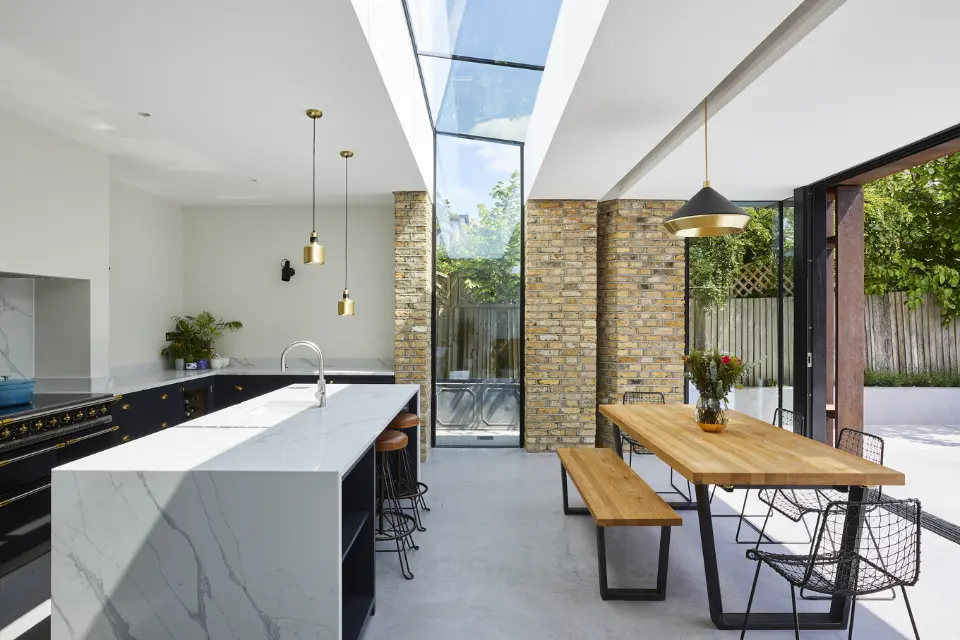
In Luxembourg, a prefab house extension (modular or timber frame) costs €1,300 to €2,600/m² excluding foundations, against €1,800–3,000 in masonry, and is built in 3 to 5 months instead of 8 to 14. Add €5,000 to €15,000 for foundations, which a kit price almost never includes.
- Price per m² (renov.lu survey, September 2026, excl. VAT): modular €1,300–2,200 · prefab timber frame €1,500–2,600 · masonry €1,800–3,000 · steel-and-glass extension €2,200–3,500
- Budget for 20 m²: €26,000–44,000 modular, €30,000–52,000 timber frame, excluding foundations; €36,000–60,000 for turnkey masonry
- Foundations and slab: €5,000–15,000 depending on the soil, whatever the system; utility connections, junction with the house, stairs and finishes are almost always outside the catalogue price
- Build time: 3 to 5 months prefabricated, including 6 to 10 weeks of workshop manufacture alongside the foundations, against 8 to 14 months in masonry
- Same rules for every system: building permit before any order, 3% VAT for your main residence (benefit capped at €50,000), energy performance certificate after the works
Get your prefab extension priced, foundations included
Kit, modular, timber frame or masonry: companies established in Luxembourg price the same full scope, foundations, utility connections and junction with the house included.
Prefab extension cost per m²: kit, modular, timber frame or masonry
A prefab extension costs €1,300–2,200/m² as 3D modules and €1,500–2,600/m² as a timber frame, excluding foundations, i.e. €26,000 to €52,000 for 20 m²; the same area in masonry comes to €36,000–60,000 turnkey. The gap between two quotes rarely comes from timber or concrete: it comes from what each one includes.
| System | Price per m² | Budget 20 m² | Budget 30 m² | What the price usually includes |
|---|---|---|---|---|
| Modular (3D modules) | €1,300 – 2,200 | €26,000 – 44,000 | €39,000 – 66,000 | Modules finished in the factory; foundations and connections not included |
| Prefab timber frame | €1,500 – 2,600 | €30,000 – 52,000 | €45,000 – 78,000 | Structure, insulation, weathertight shell; check finishes and junction |
| Kit | Catalogue price | — | — | Components only; foundations, connections, junction, stairs and finishes extra |
| Masonry (concrete block, brick) | €1,800 – 3,000 | €36,000 – 60,000 | €54,000 – 90,000 | Turnkey: shell, roof, fit-out |
| Steel and glass (glazed extension, flat roof) | €2,200 – 3,500 | €44,000 – 70,000 | €66,000 – 105,000 | Installed; slab and heating often extra |
Ranges excluding VAT, surveyed by renov.lu among companies established in Luxembourg in September 2026 (budget = price per m² × area). Precast concrete has no separate range: start from the masonry range and add the crane. The overall budget of an extension, financing and steps included, is covered in our guide to house extensions in Luxembourg.
What the price per m² does not include
| Item | Indicative price | Good to know |
|---|---|---|
| Foundations and slab | €5,000 – 15,000 depending on the soil | Conventional site work whatever the system: prefab does not remove it |
| Soil survey | €1,200 – 3,000 | Needed before sizing the foundations |
| Structural design | €800 – 2,500 for the opening in the load-bearing wall; €2,000 – 6,000 for an extension or an extra storey | Details in structural engineer costs |
| Architect | 8 – 15% of the cost of the works | Fees invoiced at 17% VAT: see architect fees in Luxembourg |
| Opening the wall, utility connections (water, electricity, heating, drainage), stairs | On quotation | The item catalogue prices leave out |
| Final energy performance certificate | About €500 – 600 for a house | Mandatory after an extension; unregulated price |
A « €60,000 kit » and an all-inclusive masonry quote do not describe the same project: ask for complete quotes, foundations, utility connections, junction with the house and finishes included, and compare them on the same scope.
Worked example: 20 m² in prefab timber frame
A 1970s house lived in by its owners, 20 m² prefab timber-frame extension at €2,200/m², finishes and junction included in the offer: €44,000 excluding VAT, plus €8,000 for foundations and slab. These €52,000 of works are invoiced at 3% VAT, i.e. €1,560 instead of €8,840 at 17%. The soil survey (€1,500), the design of the opening in the load-bearing wall (€1,200) and the architect at 10% (€5,200) stay at 17%: €9,243 including VAT. With the final energy performance certificate (about €550), the budget comes to about €63,350 including VAT, for 3 to 5 months of works instead of 8 to 14 in masonry.
Extension building systems compared
The five common systems, prefab timber frame, 3D modules, kit, masonry and steel-and-glass, can all reach the same thermal performance; they differ in build time, load on the foundations and comfort in use.
| System | Build time | Weight, foundations | Comfort |
|---|---|---|---|
| Prefab timber frame | 3 – 5 months | Light: smaller foundations, suited to an extra storey | Very good insulation; acoustics to be improved with a lining |
| Modular (3D modules) | 3 – 5 months, set in a few days | Light, but needs a crane | Dimensions limited by transport |
| Kit | Assembly in a few weeks | Light | Depends on the quality of assembly |
| Masonry (concrete block, brick, aerated concrete) | 8 – 14 months | Heavy: foundations sized accordingly | Thermal mass (summer comfort), good sound insulation |
| Steel and glass (often a flat roof) | Manufacture 8 – 16 weeks, fitting 1 – 3 weeks | Light | Overheating and cold surfaces if glazing and frames are weak |
Prefab extension: kit, modular or timber frame, how it works
A prefab extension is built in the workshop while the contractor pours the foundations at your home; the three formulas differ in what arrives finished on site, and therefore in price, build time and what remains to be done on site.
| Formula | What is delivered | Best for |
|---|---|---|
| Kit (« extension kit », « annexe kit ») | Components to assemble, put together by a local firm or as supervised self-build | Tight budget, simple layout, keen to get involved |
| Modular | Volumes finished in the factory (walls, floor, services, sometimes bathrooms), delivered by truck and craned into place in a few days | Standard layout, site accessible to a truck and a crane |
| Prefab timber frame (Holzrahmenbau) | Wall and roof panels made to the millimetre from a survey of the house, with insulation and often the windows built in, assembled on the slab | Made to measure: any shape, extra storey possible |
If you buy the kit components yourself, the invoice carries 17% VAT: the difference with the 3% rate is recovered afterwards through the AED refund procedure (overall amount above €3,000 excluding VAT, each invoice above €1,250 excluding VAT).
Build time: 3 to 5 months instead of 8 to 14
The main advantage of prefab is the schedule, not the price: the 6 to 10 weeks of workshop manufacture overlap with the foundations instead of adding to them, assembly takes a few days and the extension is weathertight straight away. Allow 3 to 5 months of works against 8 to 14 months in masonry, excluding design and the building permit procedure, with a short, dry site that is much appreciated when you live in the house.
What prefab does not change: foundations preceded by a soil survey, opening up the existing wall, roof junctions and finishes remain craftsmen’s work on site, and that is where the final quality is decided.
Timber frame or masonry: what really changes
For the same thermal performance, a timber-frame wall is thinner, because the insulation sits between the studs, and lighter; a masonry wall stores more heat, which smooths temperature peaks in summer, and insulates better against noise.
| Criterion | Timber frame | Masonry |
|---|---|---|
| Price per m² | €1,500 – 2,600 (prefabricated, excl. foundations) | €1,800 – 3,000 (turnkey) |
| Living space | Thinner walls for the same insulation: a few m² gained on a small footprint | Load-bearing wall + insulation: greater total thickness |
| Summer comfort | Low thermal mass: solar shading and dense insulation (wood fibre) recommended | High thermal mass: the room heats up more slowly |
| Acoustics | To be treated with a lining, especially for semi-detached houses or near a road | Good thanks to the mass |
| Durability | Durable when protected from moisture (plinth, ventilated cladding); ask for PEFC- or FSC-certified timber, cladding needs maintenance | Little maintenance of the structure |
Concrete slab and plinth with a timber frame above, or a steel beam for a large opening in a masonry wall: a hybrid puts each material where it performs best, provided a single contractor is responsible for the whole and its junctions.
Concrete, brick or precast concrete extension: the masonry options
A concrete extension is built either from blocks on site, for €1,800 to €3,000/m² and 8 to 14 months, or from precast concrete panels, which shorten the shell works but need a crane and foundations sized for their weight.
A block or brick extension blends naturally with a masonry house: same appearance, same render, external insulation connected without a break. Aerated concrete, more insulating in itself, does not remove the need for insulation. Precast concrete brings masonry closer to prefab timescales: for its budget, start from the masonry range, add the crane and have both options priced on the same plan.
Steel and glass or veranda: for which projects
A steel frame allows long spans and almost fully glazed façades for €2,200 to €3,500/m² with a flat roof, but glass insulates less than a wall: thermally broken frames, solar shading, an insulated roof and triple glazing are essential to use the room all year round. A good benchmark is the Klimabonus threshold for renovation windows, a Ug value of 0.6 W/m²K or less.
The deciding factor is year-round use. For a bedroom, an office or an enlarged kitchen, insulated and heated like the rest of the house, an extension is the answer and prefab makes it fast. For a light-filled room opening onto the garden, a four-season veranda costs €1,800 to €3,500/m² installed: see veranda costs in Luxembourg.
Connecting the extension to the house without a thermal bridge
An extension’s thermal bridge almost always sits at the junction with the house, where the existing wall, the new slab and the roof meet; it is dealt with by running the insulation without a break, separating the foundations and taking care of airtightness.
Continuous insulation
If the house wall is uninsulated, the extension creates a cold surface where it meets it. Insulate at least the junction area, or use the works to insulate the whole wall externally.
Slab insulated underneath and at the edges
Insulation under the slab and around its perimeter prevents heat loss through the floor, the weak point of extensions built on ground-bearing slabs.
Separated foundations
New foundations settle during the first years; a movement joint between old and new prevents cracks at the junction.
Continuous airtightness
Membrane or airtight plaster connected to the house, checked by an airtightness (blower door) test before the finishes go on.
Opening and roof
Lintel or beam calculated for the opening in the load-bearing wall; careful waterproof upstands where the extension roof meets the façade.
Permit, architect and VAT: what the system does not change
The building system changes neither the need for a building permit nor the VAT rate: prefabricated, kit or masonry, an extension creates living space and follows the same rules.
- Building permit: issued by the mayor, to be obtained before ordering a kit or modules; with no decision after 3 months, the application can be treated as refused; valid for 2 years, extendable once by one year. Procedure in our guide to the building permit and works declaration.
- Appearance: no national rule bans timber, but some municipalities impose render or refuse timber cladding or a flat roof, especially in protected areas.
- Architect: may be required depending on the municipal regulations and the scale of the project; fees of 8 to 15% of the works, at 17% VAT.
- 3% VAT: extending your main residence counts as creating housing, with no age condition, benefit capped at €50,000; the company applies for AED approval before the works. See our guide to 3% VAT.
- Energy performance certificate: mandatory after the extension, whatever the system (see the energy performance certificate); the new part does not qualify for Klimabonus.
Which building system for which project
The right system follows from four questions: do you need speed while living in the house, can the site take a crane, can the existing structure carry an extra storey, and does the municipality impose an appearance?
| Your situation | Best-suited system | Why |
|---|---|---|
| Short works, house occupied | Prefab timber frame | 3 to 5 months, dry site |
| Extra storey | Timber frame | Lower load on the existing structure, after a structural survey and with a new roof structure |
| Simple layout, easy truck and crane access | Modular | Finished modules, set in a few days, lowest price per m² |
| Hard-to-reach site | Timber-frame panels or masonry | No bulky modules to lift |
| Masonry house, semi-detached or noisy street | Masonry or precast concrete | Matching appearance, thermal mass, acoustics |
| Light-filled room onto the garden | Steel and glass, or veranda | Large openings; overheating to be controlled |
| Tight budget, supervised DIY | Kit | Low headline price, but foundations, connections and finishes on top |
Compare 3 quotes for your prefab extension
Floor area, use of the room, access to the site: describe your project and receive 3 quotes from companies established in Luxembourg, priced on the same scope, foundations, connections and junction included. Free and without obligation.
Frequently asked questions about prefab extensions
How much does a prefab extension cost per m² in Luxembourg?
Budget €1,300 to €2,200/m² for a modular extension and €1,500 to €2,600/m² for a prefab timber frame, excluding foundations and utility connections, against €1,800 to €3,000/m² for a turnkey masonry extension (renov.lu survey, September 2026, excluding VAT). For 20 m², that is €26,000 to €52,000 prefabricated, plus €5,000 to €15,000 for foundations.
What does a kit extension price leave out?
Almost never included: the foundations and slab (€5,000 to €15,000 depending on the soil), connections to water, electricity, heating and drainage, the opening of the wall and the junction with the house, any stairs and the interior finishes. Ask for complete quotes and compare them on that same scope.
How long does it take to build a prefab extension?
About 3 to 5 months of works, against 8 to 14 months in masonry. The 6 to 10 weeks of workshop manufacture run while the foundations are poured, assembly takes a few days and the extension is weathertight straight away. Design and the municipal building permit procedure come on top, beforehand.
Are there prefabricated concrete extensions?
Yes: walls made of precast concrete panels, delivered and craned into place, shorten the shell works of a masonry extension. They need crane access and foundations sized for their weight by a structural engineer. For the budget, start from the masonry range (€1,800 to €3,000/m²), add the crane, and have both options priced on the same plan.
Timber or concrete extension: which insulates better?
Both can reach the same insulation level: performance comes from the insulation and its continuity, not from the load-bearing material. A timber frame gets there with a thinner wall, since the insulation sits between the studs; masonry keeps the edge on thermal mass, which limits overheating in summer, and on sound insulation.
Does a prefab extension need smaller foundations?
A timber frame or module is lighter than masonry, which allows smaller foundations, but not none: budget €5,000 to €15,000 for foundations and slab depending on the soil, in every case. A soil survey is still needed, especially on a sloping or clay site.
Do you need a building permit for a prefab or kit extension?
Yes. A prefab, kit or modular extension creates floor area and needs the same building permit from the mayor as a masonry one. No national rule bans timber, but the municipality may impose render or refuse timber cladding or a flat roof. File the application before ordering the kit or the modules.