
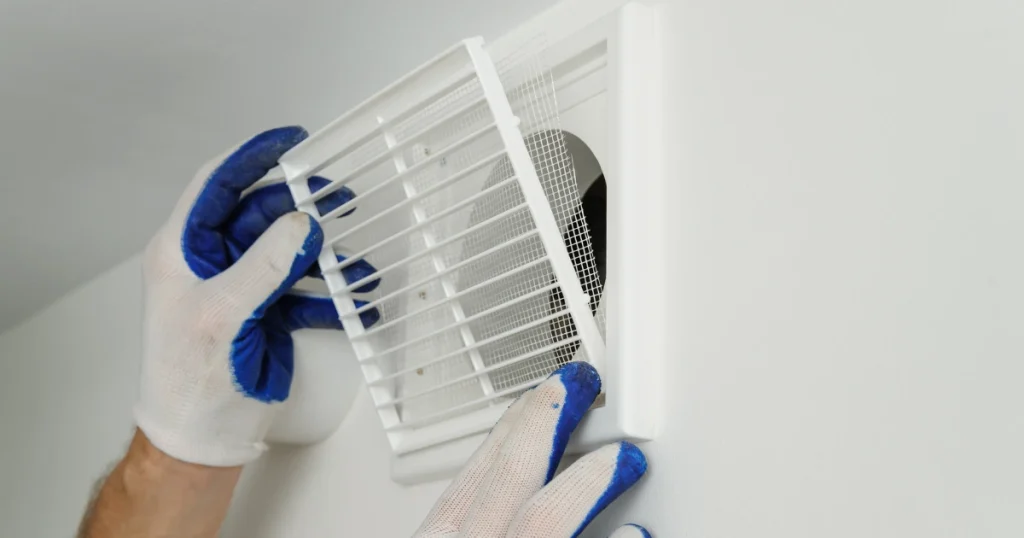
To ventilate a bathroom in Luxembourg, a humidity-controlled ventilation unit or an extractor fan is enough: the vent goes on the ceiling or high on the wall, at least 1.80 m above the floor, close to the shower, with a diameter of 80 to 125 mm depending on the air flow. Allow €450 to €1,200 fitted for a single bathroom; only whole-house heat recovery ventilation qualifies for the Klimabonus.
- Usual extract rate: 15 m³/h (shower room), 30 m³/h (bath), 45 m³/h (separate bath and shower)
- Position: ceiling or high on the wall, at least 1.80 m above the floor, near the shower, at least 20 cm from corners
- Diameter: 80 mm for 15 m³/h, 100 mm for 30 m³/h, 125 mm for 45 m³/h
- Price for one bathroom: €450-850 (constant flow), €650-1,200 (humidity-controlled), fitted
- Whole-house ventilation: €1,500-3,500 for humidity-controlled extract, €6,000-18,000 for heat recovery
- Humidity to aim for: 40 to 60% relative humidity
- Grants: no Klimabonus for extract-only ventilation or a fan; 3% VAT if a company fits it in a home at least 10 years old used as a main residence
Have ventilation fitted in your bathroom
Ventilation installers established in Luxembourg suggest the right solution for your room, with or without a full bathroom renovation.
Why a bathroom needs mechanical ventilation
A shower releases more water vapour in a few minutes than a window left ajar can remove in winter: without mechanical extraction, the vapour condenses on cold surfaces, blackens the grout and causes mould on the ceiling and in the corners.
- Health: mould aggravates allergies and asthma.
- Building: grout, sealant, paint and ceilings deteriorate quickly in a room that stays damp.
- Energy: opening the window wide after every shower in winter chills the room; mechanical extraction removes the moisture without emptying the room of its heat.
- Renovated homes: after new windows or insulation, the home becomes airtight and mechanical ventilation becomes essential. The causes of damp elsewhere in the home are covered in our guide to damp and humidity problems.
Which ventilation to choose for a bathroom
For a single bathroom, an extractor fan or humidity-controlled extract ventilation is enough; heat recovery ventilation makes sense for the whole house during an energy renovation, and it is the only system with a grant.
| System | Principle | For whom | Limits |
|---|---|---|---|
| Extractor fan (wall or ceiling, with timer or humidistat) | Starts with the light or when humidity rises | A single bathroom with no ventilation network | Ventilates one room only; air must be able to enter through the door |
| Constant-flow extract ventilation | Fixed air flow, running continuously | Tight budgets | Constantly extracts warm air, cold draughts |
| Humidity-controlled extract ventilation (type A or B) | Vents open as humidity rises; in type B the air inlets too | Most renovations | No heat recovery, no grant |
| Heat recovery ventilation (MVHR) | Extract and supply with heat recovery | Renovated or new house, whole house | Two duct networks; decided for the whole home |
Detailed comparison of systems for the whole home: extract-only or heat recovery ventilation.
Where to put the extract vent in a bathroom
The extract vent goes where the vapour collects: on the ceiling or high on the wall, at least 1.80 m above the floor, above or right next to the shower or bath.
- At least 20 cm from corners between wall and ceiling, where air swirls and is drawn in poorly.
- Away from the air inlet: the vent should be on the side opposite the door, so air crosses the room instead of looping.
- Never behind furniture or in a false ceiling without an access hatch: the vent must stay reachable for cleaning.
- Above the shower: the most effective spot, provided the unit is designed for that zone of the bathroom (protection rating and electrical safety zone); the electrician checks this.
- Air inlet: leave a gap under the door or fit a transfer grille, otherwise the fan runs to no effect.
Which diameter for the extract vent
The diameter of the vent and duct depends on the air flow to extract: 80 mm for a shower room, 100 mm for a bathroom with a bath, 125 mm for a large bathroom with a bath and a shower.
| Room | Usual air flow | Vent and duct diameter |
|---|---|---|
| Shower room | 15 m³/h | 80 mm |
| Bathroom with bath | 30 m³/h | 100 mm |
| Separate bath and shower | 45 m³/h | 125 mm |
These air flows are sizing benchmarks commonly used by installers; the exact calculation covers the whole home. The vent must match the duct diameter: a reducer creates pressure losses, noise and a lower air flow.
Installing bathroom ventilation step by step
Installing bathroom ventilation takes one to two days: the difficulty is not the unit but routing the duct to the outside.
- Choose the vent position according to the rules above.
- Route the duct to an outlet on the roof or façade, never into the loft or a false ceiling, where the moist air would condense. In a cold loft, the duct must be insulated.
- Drill and fit the external outlet, rainproof; in a co-owned building, drilling the façade or roof requires the general meeting’s approval.
- Connect the electricity through an electrician, respecting the bathroom’s safety zones.
- Provide an air inlet (gap under the door, grille) and check the air flow at commissioning.
In older flats, a shared ventilation duct sometimes exists: ask the building manager before connecting anything.
Bathroom ventilation costs in Luxembourg
Fitting a single bathroom with a motor and one vent costs €450 to €850 for constant-flow ventilation and €650 to €1,200 for humidity-controlled ventilation, fitting included; each extra wet room adds to the price.
| Installation | Equipment only | Fitted |
|---|---|---|
| Single bathroom, constant-flow extract | €150-400 | €450-850 |
| Single bathroom, humidity-controlled extract | €300-650 | €650-1,200 |
| Whole house, humidity-controlled type B (up to 120 m²) | — | €1,500-3,500 |
| Whole house, heat recovery | — | €6,000-18,000 |
Luxembourg market prices; the full grid for whole-house ventilation is on our page on ventilation installation costs. If the bathroom is fully refitted, ventilation becomes part of the job: see bathroom renovation costs.
Bathroom with no ventilation and no window: what to do
A bathroom with no window and no ventilation needs mechanical extraction to the outside; nothing else solves the damp for good.
- Extractor fan with humidistat or timer, connected to an outlet on the façade or roof: the simplest solution in a renovation.
- Connection to the home’s existing ventilation if a vent can be added without unbalancing the network.
- In the meantime: leave the door open after showering, wipe the walls, do not dry laundry in the room. An electric dehumidifier helps short term but does not replace extraction.
Grants and VAT for bathroom ventilation
Extract-only ventilation, humidity-controlled ventilation and extractor fans receive no Klimabonus; only whole-home heat recovery ventilation is subsidised, at €60/m² of reference area (€70/m² if the approval in principle is requested before 30 June 2027), within energy advice.
The 3% VAT rate instead of 17% does, however, apply when a company fits ventilation in a home at least 10 years old used as a main residence. Conditions and amounts: grants and the 2026 Klimabonus.
Frequently asked questions about bathroom ventilation
Where should the extract vent go in a bathroom?
On the ceiling or high on the wall, at least 1.80 m above the floor, above or right next to the shower or bath, at least 20 cm from corners and on the side opposite the door. It must never be hidden behind furniture and must stay reachable for cleaning.
Can you install a ventilation unit above the shower?
Yes, it is actually the most effective spot, provided the unit is designed for that zone of the bathroom, with the right protection rating and wiring that respects the electrical safety zones. Have the electrician approve the position and the model.
What ventilation suits a small bathroom with no window?
An extractor fan with humidistat or timer, 80 mm in diameter for a shower room, connected to an outlet on the façade or roof, or a humidity-controlled vent connected to the home’s ventilation. Provide an air inlet under the door, otherwise the extraction stays ineffective.
How much does bathroom ventilation cost in Luxembourg?
Between €450 and €850 fitted for constant-flow ventilation and between €650 and €1,200 for humidity-controlled ventilation, for a single bathroom. Humidity-controlled ventilation for a whole house up to 120 m² costs €1,500 to €3,500, heat recovery ventilation €6,000 to €18,000.
Should ventilation run all the time?
Yes for whole-home ventilation: switching it off lets humidity rise and encourages mould, and a humidity-controlled unit already adjusts its flow to the humidity. Its consumption is low, around 15 to 35 W for humidity-controlled extract ventilation. An extractor fan, by contrast, stops by itself thanks to its timer or humidistat.
Is bathroom ventilation subsidised?
No. The Klimabonus does not cover extract-only ventilation, humidity-controlled ventilation or extractor fans; only whole-home heat recovery ventilation is subsidised, within energy advice. Fitting by a company does, however, qualify for 3% VAT in a home at least 10 years old used as a main residence.