
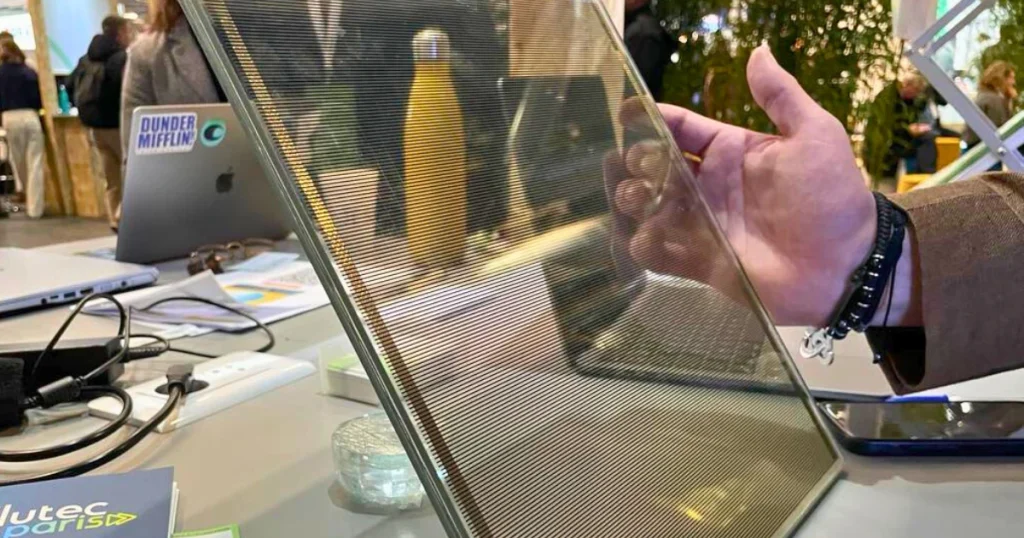
Could this be the end of solar panels? A Swiss start-up is revolutionising the sector with an innovative photovoltaic gel. The technology, which has already been tested on homes, cars and smartphone screens, could redefine the way we produce energy on a daily basis.
The first surprise is that this "photovoltaic gel" (or "PV gel") is capable of transforming any glass surface into an electricity generator.. All in a totally transparent way.
"Our gel can be applied between two layers of glass or Plexiglas. Eventually, it will even be applicable as a film, a bit like cellophane, to all facades", explains Jérémy Halimi, Marketing Manager at Emergence Solar.
Technology that defies the norm
The innovation is based on the use of perovskiteis an abundant mineral in the earth's crust. In fact, it is the most abundant mineral.
"Unlike the silicon used in conventional solar panels, perovskite is easy to recycle and not at all scarce," he points out.
The performance of this photovoltaic gel is particularly impressive. "On a conventional solar panel, your yield will be between 16 and 18%. A little more if you're lucky. Our gel has a yield of 26%" he adds.
This figure is all the more remarkable given that gel is transparent at 90%, unlike photovoltaic panels, which are totally opaque. In plain English: You can use this gel in windows and see through them without any problem.
Practical applications already tested
Many ideas look great on paper. But few make it to the marketing stage. In the case of this photovoltaic gel, tests in real-life conditions have already begun, and the results are promising:
In the building
There are many applications in the property sector. In fact, this is the main market: enabling energy to be produced from the external envelope of a dwelling (windows, facade, roof).
"For a 100 square metre house, if we manage to get 30 square metres of our solution in the glazing or in the façades, we get complete self-consumptionprovided you have a battery, of course", explains Jérémy Halimi.
If you equip 30% of living space in your home of this photovoltaic gel, you can in theory become energy self-sufficient. No more high gas, electricity or heating oil bills!
In the automotive sector
The results are just as encouraging when the gel is applied to car components: "We carried out tests on a small Fiat 500 hybrid. We fitted our photovoltaic gel to the panoramic roof, windows, door mirrors, headlights (etc.)... In the end, we managed to increase the range by 25 km a day. Without doing anything, you recover 25 km a day" explains the manager.
"Even on a smartphone, we did some impressive tests," he continues. "We left it outside in the shade and recovered around 30% of battery over a day."
An intelligent, adaptive solution
The innovation goes even further, with a unique feature: "As well as generating electricity, our gel also incorporates OLED technology. In concrete terms, linked to a home automation systemWhen you leave your house and close the door, the windows will turn black to prevent the heat from coming in during the summer," explains Jérémy Halimi.
This technology therefore has a dual effect: on the one hand, it produces electricity with a very high level of efficiency, and on the other, the opacity of the glazing can be completely adjusted.
What impact will this have on buildings?
As far as real estate is concerned, this photovoltaic freeze would be of interest in 2 cases:
- In new projects, of course (VEFA): the windows installed would benefit directly from this photovoltaic gel between their 2 or 3 layers of glazing. Such consumption would greatly improve the energy passport of the property: it would be much easier to produce A or A+ rated homes.
- For renovation projects: In the short term, by installing new windows during major renovations. In the long term, by applying films over existing glazing, facade or roof to capture the sun's energy.
Imminent deployment
Already awarded at the Geneva International Exhibition of Inventions 2023, the company is preparing its commercial roll-out. "We will soon be integrating our solution into new property developments in Europe, at a number of pilot sites," explains Jérémy Halimi.
Our system represents the future of the photovoltaic market. It's a versatile, economical and aesthetically appealing solution for integrating solar energy into our environment.
With a guaranteed life cycle of at least 20 years and an energy debt repaid in just one yearThis technology is perfectly in tune with the challenges of the energy transition.